You Won’t Believe These Hidden Architectural Gems in Mandalay
Mandalay isn’t just about bustling markets or golden pagodas—its architecture tells a deeper story. I wandered through quiet alleys and ancient compounds, stunned by the craftsmanship most tourists never see. From weathered teak monasteries to colonial-era buildings with intricate woodwork, every structure feels alive with history. If you're craving authentic, off-the-beaten-path beauty, Mandalay’s architectural secrets will blow your mind. Let me take you where the real magic hides.
The Soul of Mandalay Lives in Its Wooden Monasteries
Among the most exquisite expressions of Burmese architectural artistry are the wooden monasteries that have withstood centuries of sun, monsoon, and time. At the heart of this tradition stands Shwenandaw Monastery, the only surviving structure from the original Mandalay Palace complex built by King Mindon in the mid-19th century. Unlike the gilded spires seen elsewhere, this sanctuary is crafted entirely of teak, its golden hue softened by age into a warm amber that glows under the morning light. Every surface tells a story—delicate carvings of mythological beings, floral motifs, and scenes from the Jataka tales spiral across pillars, friezes, and eaves, each chiseled by hand using techniques passed down through generations of master artisans.
Walking into Shwenandaw feels like stepping into a living museum of spiritual craftsmanship. Sunlight filters through intricately latticed windows, casting lace-like patterns across the wooden floorboards, while the air carries the faint, earthy scent of aged teak—a fragrance that evokes both reverence and nostalgia. The monastery’s design reflects deep Buddhist principles: symmetry symbolizing balance, elevated platforms representing detachment from worldly concerns, and open-air corridors encouraging mindfulness and contemplation. These elements are not merely decorative; they are integral to the monastic way of life, creating spaces that support meditation, learning, and communal harmony.
What makes Shwenandaw especially significant is its royal origin. Originally part of the royal palace within the walled city of Mandalay, it was dismantled and reassembled at its current location after King Thibaw, Mindon’s son, moved it to honor his father’s memory. This act of preservation speaks volumes about the cultural value placed on architectural heritage in Burmese society. Today, visitors can witness monks moving quietly through the halls, their saffron robes brushing against centuries-old wood, a seamless thread connecting past and present. The monastery stands not as a relic frozen in time, but as a breathing testament to continuity, faith, and the enduring power of skilled hands shaping sacred space.
Colonial Echoes on 30th Street: A Forgotten Chapter
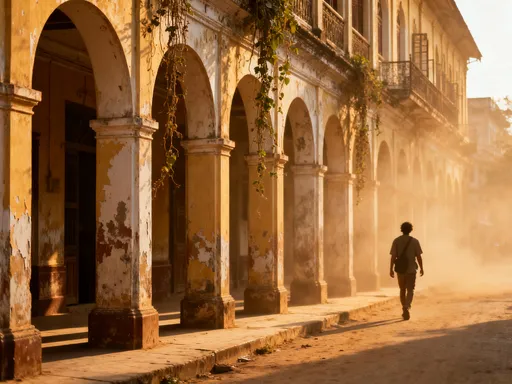
Just a short walk from the spiritual heart of Mandalay lies a quieter, more melancholic chapter of its architectural history—colonial-era buildings quietly aging along streets like 30th Road, once the administrative spine of British Burma. These structures, built primarily between the late 1800s and early 1900s, stand in dignified decay, their arched verandas, tall shuttered windows, and red-brick facades whispering stories of a complex past. Peeling paint reveals layers of history beneath, and rusted iron railings curve like forgotten verses of a poem. Yet, there is beauty in this quiet abandonment—an aesthetic of resilience, where time has softened edges but not erased significance.
The British colonial presence in Mandalay was brief but impactful. After the fall of the Konbaung Dynasty in 1885, the British transformed the city into a regional administrative center, constructing offices, residences, and warehouses that blended European neoclassical styles with local adaptations for tropical living. High ceilings allowed hot air to rise, wide eaves provided shade, and ventilation was maximized—practical responses to Mandalay’s intense heat. What’s remarkable today is how these buildings, though foreign in origin, have gradually been absorbed into the city’s architectural fabric. Some now serve as government offices; others house small businesses or private homes, their colonial bones quietly coexisting with Burmese life.
Preservation efforts remain limited, but growing awareness has sparked interest in conserving these architectural hybrids. Local historians and urban planners emphasize that these buildings are not symbols of occupation alone, but records of cultural exchange and adaptation. A restored colonial bungalow with repointed brickwork and freshly painted shutters can stand beside a street vendor’s cart without dissonance—each contributing to Mandalay’s layered identity. For the observant traveler, walking these streets becomes an act of discovery: noticing how Burmese families have personalized verandas with potted plants, or how modern signage contrasts with century-old stonework. These buildings remind us that cities are palimpsests—written over, yet never fully erased.
Kuthodaw Pagoda: Where Stone Meets Scripture
Rising from the base of Mandalay Hill like a field of white lotus blossoms is Kuthodaw Pagoda, home to what is often called the “World’s Largest Book.” This extraordinary site consists of 729 small stupa-like structures, each housing a marble slab inscribed with a page of the Tripitaka—the complete teachings of the Buddha. Commissioned by King Mindon in 1857 as an act of merit and national preservation, the project involved hundreds of scholars, scribes, and stone carvers working in unison to transcribe sacred texts into enduring stone. Today, walking among these alabaster stupas under the vast Burmese sky feels like wandering through a library of silence, where knowledge is not read but felt.
The architectural arrangement of Kuthodaw is both precise and symbolic. The stupas are laid out in neat rows within a square courtyard, reflecting the Buddhist emphasis on order and harmony. Each miniature stupa is crowned with a bell-shaped dome and a spire topped with a hti (umbrella-like finial), echoing the design of larger pagodas but on a human scale. The marble slabs inside are protected from the elements by glass cases, their ancient script still legible—curved Burmese characters flowing across smooth stone like rivulets of thought. The sheer labor involved in creating this monumental archive underscores the deep connection between architecture and spirituality in Burmese culture: buildings are not just shelters, but vessels of wisdom and devotion.
Visitors often linger here longer than expected, drawn by the meditative rhythm of the repeating forms and the sense of sacred permanence. Unlike more ornate temples, Kuthodaw’s power lies in its simplicity and scale. It does not dazzle with gold or intricate murals; instead, it humbles with its quiet dedication to preservation. Monks sometimes sit beneath the shade of a tree nearby, reciting passages from memory, linking oral tradition with written legacy. For families visiting from nearby towns, the site is both educational and inspirational—a place to teach children about discipline, faith, and the value of knowledge. In an age of digital impermanence, Kuthodaw stands as a powerful reminder that some truths are worth carving in stone.
Forts, Walls, and Moats: Mandalay Hill’s Guardian
Encircling the base of Mandalay Hill is one of Southeast Asia’s most impressive examples of traditional fortress architecture—the Mandalay Palace complex. Built as the seat of the last Burmese monarchy, the palace sits at the center of a perfectly square citadel, surrounded by a wide moat, massive brick walls, and four main gatehouses aligned with the cardinal directions. This geometric precision is no accident; it reflects ancient cosmological beliefs, where the earthly capital mirrors the structure of the universe, with the palace at its spiritual and political center. Even in its reconstructed form, the fortification exudes authority, order, and a deep sense of place.
The original palace, completed in 1859, was largely destroyed during World War II bombings, but meticulous restoration efforts in the 1990s brought back much of its former grandeur. The outer walls, stretching over six kilometers, are constructed from baked brick and rise several meters high, punctuated by watchtowers and fortified gates. The moat, still filled with water, adds both defensive function and aesthetic serenity, its surface often reflecting the sky like a mirror. Walking along the ramparts, one can appreciate the strategic brilliance of the design: wide enough for guards to patrol, high enough to deter invaders, and symmetrical enough to satisfy both military and metaphysical needs.
Inside the walls, the palace grounds unfold in a series of courtyards, throne halls, and administrative buildings, though many interiors are now museums or ceremonial spaces. The central Glass Palace, once resplendent with mirrors and gilded wood, was lost to fire, but its foundation and layout remain. What strikes visitors most is the sheer scale of the complex—it covers over 400 acres, making it one of the largest palace enclosures in Asia. Yet, despite its size, the atmosphere is surprisingly peaceful, especially in the early morning when sunlight gilds the rooftops and birds call from the trees within the walls.
For local families, the palace grounds are not just a historical site but a living part of daily life. Children fly kites near the moat, elders practice tai chi along the paths, and couples stroll beneath the shade of tamarind trees. This integration of heritage and community life exemplifies how architecture, even when restored, can remain relevant. The walls that once protected a king now shelter the collective memory of a nation, standing as a quiet guardian of identity in a changing world.
Hidden Shrines and Unmarked Temples in the Old Quarters
Beyond the major landmarks, Mandalay’s true architectural soul reveals itself in its quiet residential neighborhoods, where unassuming brick stupas and family-run wats nestle between homes and market lanes. These modest temples, often unnamed and unlisted in guidebooks, are maintained by local devotees who sweep courtyards, repaint faded murals, and light candles before weathered Buddha images. Unlike the grandeur of tourist-frequented sites, these spaces radiate humility and sincerity—a kind of sacred simplicity that speaks directly to the heart.
In neighborhoods like Aung Myay Thar Zan or Chan Aye Thar Zan, one might stumble upon a small temple with a roof shaped like a lotus bud, its finial slightly askew from years of wind and rain. Others feature hand-painted glazed tiles in turquoise and gold, depicting scenes of heavenly beings or floral patterns that shimmer faintly in the afternoon light. Some stupas are wrapped in bright ceremonial cloths; others have small offerings of flowers and fruit placed at their bases by passersby. These details, though minor, reflect a living tradition—one where architecture is not frozen in time but continuously renewed through devotion.
Encounters with caretakers often lead to warm conversations. An elderly woman sweeping leaves might explain that her family has tended the temple for three generations. A young monk might invite you to sit in the shade and share stories about festivals celebrated here each year. These human connections deepen the appreciation of the structures themselves, reminding visitors that architecture is not just about form and function, but about community and continuity. These hidden shrines may lack the fame of Kuthodaw or Shwenandaw, but they possess something equally valuable: authenticity. They are not built for spectacle, but for service—to faith, to memory, to everyday life.
Modern Meets Traditional: Contemporary Burmese Design Touches
While Mandalay honors its past, it is not frozen in it. Across the city, a quiet architectural evolution is underway—one that respects heritage while embracing modern needs. New cultural centers, boutique guesthouses, and private homes increasingly incorporate traditional Burmese elements in thoughtful, sustainable ways. Pitched roofs with wide overhangs, central courtyards for natural ventilation, and carved wooden eaves are no longer reserved for temples and palaces but reimagined for contemporary living.
One notable example is a small cultural retreat near the Ayeyarwady River, where low-rise buildings blend seamlessly into the landscape. Constructed with locally sourced teak and brick, the structure features open-air corridors, latticed windows for privacy and airflow, and a central courtyard planted with frangipani trees. Inside, modern amenities coexist with traditional craftsmanship—hand-carved panels frame doorways, while solar panels discreetly power the building. The design does not imitate the past but interprets it, creating spaces that feel both familiar and fresh.
This approach reflects a broader shift in Burmese architectural philosophy: preservation through adaptation rather than replication. Architects and homeowners alike are recognizing that cultural identity need not be preserved in amber. Instead, it can grow—like a tree adding new rings each year. By integrating classic motifs into modern structures, they ensure that traditional aesthetics remain part of daily life, not just museum exhibits. For visitors, this means experiencing a city that is not stuck in time, but thoughtfully moving forward, carrying its legacy with grace.
How to Experience Mandalay’s Architecture Like a Local
To truly appreciate Mandalay’s architectural richness, one must slow down. The city reveals its secrets not in hurried snapshots, but in quiet observation. Begin early in the morning, when the golden light softens stone and wood alike, and crowds are still sparse. Start at Shwenandaw Monastery, then walk toward Kuthodaw Pagoda, allowing time to pause, breathe, and absorb the stillness. From there, a gentle climb up Mandalay Hill offers panoramic views of the palace walls and the surrounding plains—an ideal moment to understand the city’s geometric layout.
For a deeper exploration, venture into the older residential districts on foot or by bicycle. Hire a local guide—preferably one affiliated with a community-based tourism initiative—who can lead you to hidden courtyards, introduce you to caretakers, and explain the symbolism behind architectural details. Respect is paramount: remove shoes before entering religious sites, avoid pointing feet toward Buddha images, and ask permission before photographing people or private spaces. Dress modestly, carry water, and allow yourself to get slightly lost; some of the most memorable discoveries happen by accident.
Consider timing your visit around a local festival, when temples are decorated with lanterns, and the air fills with the scent of incense and offerings. These moments animate the architecture, turning stone and wood into living stages of culture and faith. Whether you spend a day or a week, approach Mandalay not as a checklist of sights, but as a story written in wood, brick, and devotion. The city does not shout its beauty—it whispers it, patiently waiting for those willing to listen.
Mandalay’s true essence isn’t in postcard views—it’s carved in wood, etched in stone, and whispered through forgotten halls. Its architecture invites you not just to look, but to feel the weight of time and devotion. By stepping off the beaten path, you don’t just see the city—you connect with its soul.