You Won’t Believe What I Saw in Pompeii – A Secret Like No Other
Standing where people lived nearly 2,000 years ago, Pompeii hit me in a way no history book ever could. The preserved streets, the ash-covered ruins, the silent stories etched in stone — it’s not just a site, it’s a moment frozen in time. I went expecting ancient walls, but left with chills down my spine. This isn’t just sightseeing — it’s feeling history breathe. Every step through the cobbled lanes feels like a whisper from the past, a reminder that life once unfolded here with laughter, labor, and love. To walk Pompeii is to witness not only destruction but the delicate, enduring texture of everyday existence, suspended beneath layers of volcanic ash.
The First Step Into the Past
Passing through the Porta Marina, the main entrance to Pompeii, is like crossing a threshold not just into an archaeological site, but into another world. One moment, you're surrounded by the hum of modern Italian life — scooters buzzing, cafes serving espresso, sunbathers heading to the Amalfi Coast. The next, your feet meet ancient volcanic stone worn smooth by centuries of time and the tread of Roman sandals. The contrast is immediate and profound. This is not a reconstruction or a curated exhibit behind glass; it is a city, abandoned in an instant and preserved with eerie clarity.
The scale of Pompeii is staggering, yet intimate. Covering approximately 163 acres, the site reveals a meticulously planned urban center with wide thoroughfares, narrow alleyways, public baths, markets, and private homes. Unlike grand monuments such as the Colosseum or the Pantheon, which inspire awe through architectural grandeur, Pompeii evokes emotion through familiarity. The streets are laid out in a grid pattern, a testament to Roman engineering, and many still bear deep grooves carved by the iron wheels of carts — silent evidence of daily commerce and movement. These ruts, worn into the basalt paving stones, are not replicas; they are original, untouched since 79 AD.
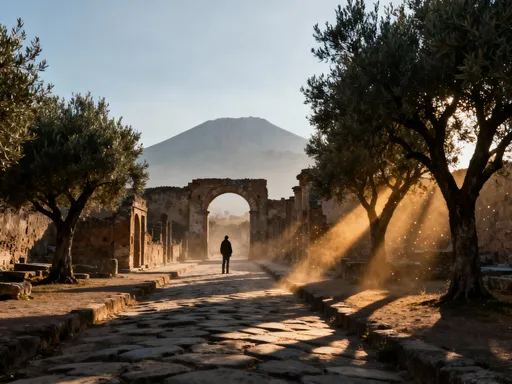
As sunlight filters through the canopy of olive and fig trees that now grow among the ruins, it casts dappled patterns across cracked walls and fragmented mosaics. The air carries the scent of dry earth and wild herbs — thyme and rosemary — that have taken root in the crevices of ancient walls. There is a stillness here that is not empty, but full — full of memory, of presence. The stones seem to absorb sound, making every footstep feel deliberate, every breath more conscious. This is not merely a visit to the past; it is an immersion in it, a rare opportunity to walk where ordinary people once lived, worked, and dreamed.
Why Pompeii Feels Different From Any Other Ruin
Many ancient sites inspire wonder, but few provoke introspection the way Pompeii does. Unlike the pyramids of Egypt or the temples of Greece, which stand as monuments to power and divinity, Pompeii reveals the fabric of daily life. It is not the grandeur of emperors or gods that captures the heart here, but the traces of ordinary people — a baker kneading dough, a child playing in the street, a merchant haggling over prices. This human scale is what makes Pompeii uniquely moving. It does not ask you to marvel at its size or symmetry; it asks you to recognize yourself in its remains.
Perhaps the most haunting element of Pompeii is the series of plaster casts created from voids in the volcanic ash. When the eruption of Mount Vesuvius buried the city, it left behind cavities where bodies once lay. Archaeologists, led by Giuseppe Fiorelli in the 19th century, developed a technique of pouring liquid plaster into these spaces, capturing the final moments of the victims in heartbreaking detail. These casts — of a man clutching his head, a dog curled in agony, a family huddled together — transform abstract history into intimate tragedy. You are not observing distant events; you are standing beside people in their last seconds of life.
Equally powerful are the preserved homes, shops, and public spaces that offer a window into Roman domestic life. The House of the Vettii, once owned by wealthy freedmen, features vibrant frescoes depicting mythological scenes, while the thermopolia — ancient fast-food counters — still have embedded jars where hot meals were once served. Graffiti on the walls includes election slogans, romantic declarations, and even complaints about poor service. These details do not glorify the past; they humanize it. Walking through a Pompeian home, you can almost hear the clatter of dishes, the laughter of children, the murmur of conversation. This is not history as spectacle — it is history as experience.
The Secret Viewing Spots Most Tourists Miss
While the Forum and the Amphitheater draw the largest crowds, some of the most profound moments in Pompeii occur in quiet corners, away from the main pathways. These lesser-known vantage points offer solitude, reflection, and a deeper connection to the site’s emotional resonance. One such place is a secluded bench near the Villa of the Mysteries, tucked behind a row of ancient columns. From here, you can gaze across the vine-covered ruins with Mount Vesuvius rising faintly in the distance. In the early morning light, mist drifts over the excavation site, and the world feels suspended between past and present.
Another hidden gem is an elevated stone path behind the Temple of Apollo, once part of a residential district. This quiet walkway provides an unobstructed view of the Forum, allowing you to see the layout of the city as a whole — the alignment of temples, markets, and public squares. It is an ideal spot to pause and imagine the city in its prime, bustling with activity, the sound of voices echoing off marble columns. Few tourists climb this path, making it a sanctuary for contemplation.
Equally powerful is a narrow alleyway between two residential blocks, just east of the Lupanar, Pompeii’s well-preserved brothel. From this tight passage, there is a direct, frame-like view of Mount Vesuvius, the very mountain that destroyed the city. Standing here, especially at sunset, creates a moment of eerie clarity — the same volcano that looms so peacefully today once unleashed unimaginable destruction. These secret spots do not offer better photographs; they offer better presence. They invite you to slow down, to listen, to feel the weight of time not as a concept, but as a lived reality.
How Light and Time Change the Experience
The atmosphere of Pompeii shifts dramatically depending on the time of day, offering entirely different emotional experiences. Morning visits, especially between 8:30 and 10:00 AM, are ideal for those seeking both comfort and connection. The air is cooler, the light soft and golden, casting gentle highlights on the pale stone and illuminating the intricate details of mosaics and frescoes. Shadows are short, and the site feels more accessible, almost welcoming. This is the best time to appreciate the artistry of the ancient world — the delicate brushstrokes in wall paintings, the precision of mosaic tiles depicting mythological creatures.
By midday, the sun climbs high, and the temperature rises significantly, especially in summer. The ruins, lacking much shade, become exposed and stark. While this can be physically taxing, it also amplifies the sense of desolation. The harsh light bleaches the stones, emphasizing cracks, collapses, and the passage of time. The silence feels heavier, the emptiness more profound. For some visitors, this intensity deepens the emotional impact — the city’s abandonment feels more real under the unrelenting sun.
But it is in the late afternoon, after 3:00 PM, that Pompeii reveals its most haunting beauty. As the sun begins to descend, long shadows stretch across the streets, creating dramatic contrasts between light and darkness. The warm, amber glow softens the edges of broken walls and gives the ruins a painterly quality. This is also when the crowds begin to thin, allowing for uninterrupted moments of stillness. You might find yourself alone in a quiet courtyard, the only sound the rustle of leaves or the distant call of a bird. These final hours before closing offer a rare opportunity to experience Pompeii not as a tourist destination, but as a place of memory — a sanctuary where time itself seems to pause.
Reading the City: What the Walls and Floors Tell You
To truly understand Pompeii, one must learn to read it — not in books, but in the stones, the walls, the floors. The city is filled with inscriptions, graffiti, and decorative elements that speak directly to the lives of its inhabitants. These are not formal records or official decrees, but spontaneous, personal messages — the ancient equivalent of social media posts. On the walls of homes and shops, you’ll find slogans like “Salve, Lucru” (“Hello, profit”), “I won at dice,” and even romantic notes such as “No one loves me.” These fragments of everyday speech bridge the gap between then and now, making the past feel startlingly familiar.
The mosaics, too, are rich with meaning. In the House of the Faun, one of the largest private residences in Pompeii, a famous floor mosaic depicts the battle between Alexander the Great and Darius III of Persia. Crafted from thousands of tiny tesserae, the artwork is a masterpiece of detail and perspective. But equally telling are the simpler mosaics — a dog at the entrance with the word “Cave Canem” (“Beware of Dog”), or images of fish and fruit in dining rooms, symbolizing abundance and hospitality. These were not merely decorative; they communicated identity, status, and values.
Shop markings and electoral notices also provide insight into civic life. Painted slogans on walls promoted candidates for local office, often with endorsements like “The fruit-sellers support Holconius for duumvir.” These were not abstract political campaigns, but grassroots efforts in a functioning community. Even the street signs — stones placed at intersections to slow down carts — reveal a society concerned with safety and order. Every element, from grand frescoes to scratched initials, contributes to a portrait of a vibrant, complex city. To walk Pompeii is to read a story written in stone, one that continues to unfold with every new discovery.
Navigating Pompeii: A Practical Approach to Meaningful Viewing
To make the most of a visit to Pompeii, a thoughtful approach is essential. The site is vast, and without a plan, it’s easy to become overwhelmed or miss its quieter, more meaningful moments. A recommended route begins at the Forum, the heart of public life in ancient Pompeii. Here, surrounded by temples, a marketplace, and government buildings, visitors gain a sense of the city’s civic and religious importance. The open square, once paved with stone and lined with columns, offers a panoramic view and serves as an ideal starting point for orientation.
From the Forum, moving west into the residential districts allows for a transition from public to private life. Areas such as Regio VI and Regio IX contain well-preserved homes, including the House of the Tragic Poet and the House of Pansa. These homes, though modest by imperial standards, reveal the tastes and lifestyles of Pompeii’s middle and upper classes. Many feature central atriums with impluvium pools, gardens with fountains, and walls adorned with frescoes. Taking time to explore these spaces fosters a deeper appreciation for domestic life in the ancient world.
The journey can conclude at the Amphitheater, one of the oldest surviving Roman amphitheaters and a testament to the city’s cultural life. Hosting gladiator games and public events, it could seat up to 20,000 people — nearly the entire population of Pompeii. Standing in the arena, you can almost hear the roar of the crowd, the clash of swords, the tension of competition. This powerful finale underscores the vibrancy of a city that was, until the eruption, very much alive.
Practical considerations are equally important. Comfortable walking shoes are essential — the stone streets are uneven and can be slippery. Sun protection, water, and a hat are recommended, especially in summer months. While guided tours and audio guides provide valuable context, it’s wise not to let them dominate the experience. Pausing frequently, sitting in quiet corners, and allowing moments of silence can be just as enlightening as any historical fact. A simple paper map, available at the entrance, often suffices for navigation, leaving the mind free to absorb the atmosphere without digital distraction.
Why This Experience Stays With You
Long after leaving Pompeii, its presence lingers. It is not the kind of place you simply check off a travel list; it is one that settles into your thoughts, reshaping your perception of time, life, and memory. Returning to the rhythm of daily routines — grocery shopping, commuting, family dinners — feels different. The ordinary seems more precious, more fleeting. Pompeii does not merely show you ruins; it makes you feel the weight of time, the fragility of existence, and the quiet endurance of human traces.
What makes this site so unforgettable is its ability to collapse the distance between past and present. You are not just observing history from afar; you are walking through it, touching it, breathing the same air that once filled the lungs of those who lived here. The plaster casts, the graffiti, the worn stones — they are not relics behind glass. They are invitations to empathy, to connection, to remembrance. In a world that moves so quickly, Pompeii offers a rare pause, a moment to reflect on what endures and what does not.
Ultimately, Pompeii is not about death — it is about life. It is a testament to the routines, relationships, and aspirations that define us, preserved not by intention, but by catastrophe. And yet, in that preservation, there is a kind of victory. The people of Pompeii did not survive, but their stories did. Their homes, their jokes, their hopes — all frozen in ash — continue to speak. To visit Pompeii is to listen. And in listening, we remember that even the smallest moments matter, that every life leaves a trace, and that time, though relentless, can sometimes stand still — if only for a moment.